When Goenka says “Vipassana”, the double ‘s’ is with a “shh” as in “be quiet”.
Goenka is the lovable and universally esteemed teacher whose chanting and advice framed the ten-days of silent meditation that we undertook over the new year. The center where we stayed is near Sarnath, in northern India. It’s a small town famous for being the first place the enlightened Buddha gave sermon. We didn’t plan to do a Vipassana in Sarnath for that reason, but it felt meaningful anyway. It is said that the Buddha was practicing Vipassana when he became enlightened.
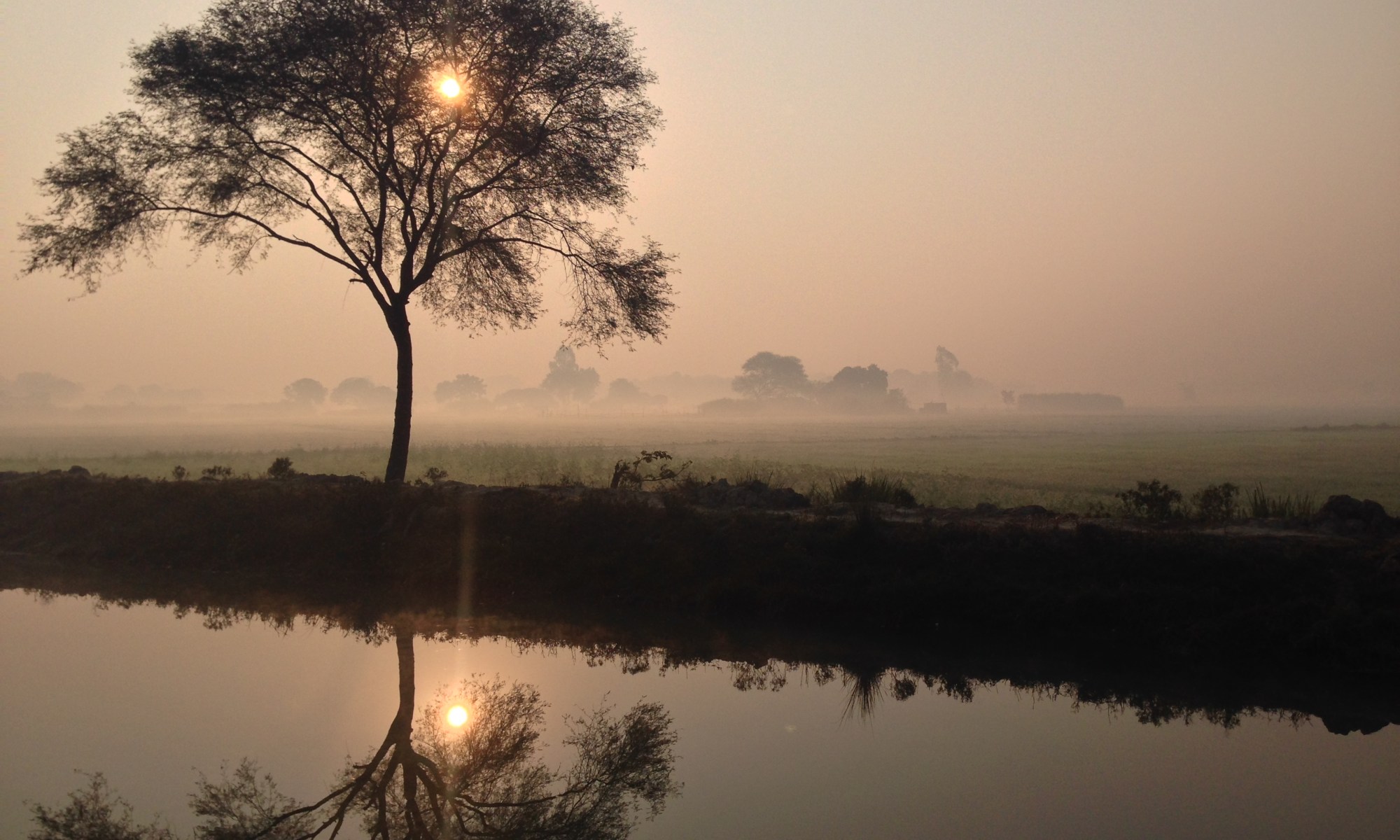
The meditation center stood alone amidst endless green fields, which were so flat that they seemed to slope downwards in all directions until they dissolved into the permanent mist. We stood next to a drainage ditch near the entrance of the center, on the day we arrived, tightly clutching our last few minutes of freedom. The ditch was home, that afternoon, to a dozen species of birds, and much plastic. Further up the stream, street dogs feuded over the right to sink their canines into a bloated carcass that was floating in the water.
The center was a large, walled garden. It also contained a meditation hall, classrooms, dining halls and dormitories. Our rooms were very basic. Just two, low, hard beds and a rusty shelf. Translucent geckos watched in the window.
For the first three days of the course we practiced Anapana meditation, designed to help calm and sharpen the mind. Anapana would prepare us for the more difficult work of Vipassana meditation which we would practice for the remaining seven days. We began following the fundamental tenets of Vipassana immediately. By the time the first night fell we had already gone into silence and had been separated according to sex.
On the first day our task was simple: we were to sit on our assigned cushions and observe our breath as we felt it occurring within our noses and on our upper lips. Goenka pointed to this triangular area on his own face; it was particularly well delineated by the deep grooves that bordered either side of his nose and mouth, marking the edges of his formidable cheeks.
I quickly discovered that I knew neither how to sit nor how to breathe. I wriggled incessantly on my seat, crossing and uncrossing my legs. My neighbor and I took turns straightening our legs in the narrow isle in front of us. The pain was severe. My right knee and hip became firey chunks of coal, which were connected not by my femur but by a piece of steel cable, which was twisting, fraying, and splitting. Two searing brands sunk into my skin on either side of my spine, between my shoulder blades. I developed a kind of whiplash. By the end of the day, I could hardly move my head at all. I tried to keep my back straight. But my muscle structure seemed unaccustomed to proper posture. I slowly slumped over. It occurred to me that I might have voluntarily agreed to waste ten of my life’s precious days. I began to suspect that the men and women had been separated to stop couples from plotting their escape. Drowning in discomfort, my breath became shallow and incomplete. I tried to force it into a natural pattern. I had forgotten that the point of the exercise was to learn to observe the breath objectively.
The second day proceeded similarly, but this time we studied our breath only on our upper lips. On the third day we tried to detect other types of sensations, such as itching, tingling, pressure and temperature change. By the fourth day I could see progress. My awareness of the skin-level sensations under my nose had sharpened, despite spectacular aching elsewhere. But by then I had also begun to worry. I feared that we would soon be asked to sit through long periods in complete stillness. On the morning of the fourth day I challenged myself to an entire hour without moving
The first half hour was easy. The rest was unbearable. As the pain steadily cranked itself up, my mind split into two. One half screamed in agony, while the other half wrung out its hands hoping the screaming mind wouldn’t implode. Finally Goenka’s ancient Buddhist chanting broke out from the speakers, marking the final five minutes of the hour. I didn’t want to let myself move until his song had stopped, though he seemed to belch each syllable with increasing slowness. Then it was over. It took me a minute just to uncross my legs. I could feel nothing but elation.
That afternoon we left the Anapana meditation behind and moved on to Vipassana. Our schedule remained mostly the same: roughly ten hours of seated meditation each day, starting at four-thirty in the morning and ending at nine at night. We had breaks for breakfast, lunch and a five PM snack consisting of chai and a small bowl of dry, savory rice crispies. No dinner. “The meditators stomach should not be more than three-quarters full.” We sat in sessions lasting between one and two hours. Some of these sessions were unguided. Most opened with several minutes of chanting and instruction-giving by Goenka. For three one-hour sessions we were not to move.
****
Vipassana teaches its practitioner to see that everything in the universe, down to the trillions of subatomic particles that compose each of us, is impermanent. Practitioners have a word for this impermanence: they call it Anicca (the double ‘c’ makes a “ch” as in ‘change’).
We are to understand the principle of impermanence by observing it in the sensations in our own bodies. Every sensation we feel, obvious or subtle, pleasant or unpleasant, is an indication that some kind of change is taking place
We practiced observing these sensations objectively, not reacting to them as they arose, for they were all united in their impermanence, in the fact that they would all at some point disappear. It became just a little bit easier to keep myself together in moments of deep discomfort. There were times in these hours of practice when I found that I could dissolve sharp pain simply by observing it. In time I learnt to experience all sensations, pleasant or not, as one identical flow of feeling.
****
Not everything in our shrunken world respected the ‘Noble Silence’. Outside the compound walls, at dusk, packs of feral dogs howled. We fell asleep to the sound of trains bound for Varanasi: metal over metal, forlorn foghorns. In the garden, wildfolk busily executed their daily lives. The jungle bablers were the most gregarious of all the creatures. They are relatively indistinguishable greyish birds, until one notices their severe, aquiline eyes. The bablers flew from tree to tree as a single flock, gossiping noisily. Inside the meditation hall, surprisingly frequent snoring emanated from the men’s side. It did not harmonize with the stone cutting work for a new pagoda just outside.
As well as having separate dorms and dining halls, men and women used distinct pathways to stretch their legs. We were under no circumstances to signal to each other or make eye contact. The staff need not have worried so much. For several days a cool and humid mist lay on the ground so heavily that, from the women’s quarters, the men appeared like mere shadows. In this mist it rained, but only where there were trees with leaves to precipitate liquid from cloud. I sought shelter from the rain out on a small, worn piece of lawn in the middle of the compound.
One fine afternoon a male staff member hurried towards me, agitated, as I stood on this lawn absorbing sun into my face. I had strayed too close to the men’s area and was being reprimanded. I skulked back into the gloomy trees, concealing my embarrassment from myself with grumpy, misdirected feminist thoughts about gender segregation…
Sideways light filtered across a patch of moss on the stone footpath. I felt a pleasant nostalgia for autumn and it brought my mind back to the principle of impermanence. My emotions were providing me with true and challenging practice.
Mourning the lawn, I walked over to a sunny log next to the compound’s trash pile, which I had, until then, very actively ignored. Two five-striped squirrels were grooming each other on the exterior brick wall, under some barbed wire. Between my log and the rubbish lay several cut branches whose drying leaves partially covered the puddle of sewage water coming from the kitchen. Several tiny birds, including (perhaps) a laughingthrush and a tailorbird, were skipping between the branches. A weasel was scavenging in the banana peels. Then a second weasel descended from a narrow tree and a third hopped over from across the garden, dropping momentarily into the shelter of a drain to consider its surroundings. It was an infestation! I had discovered a profound source of entertainment for my coming lunch breaks.
I wandered over to the sunny log the next day, same time. The show began the minute I took my seat. A weasel trotted past me towards the garbage. On the wall above it, a squirrel had been napping flat on its belly, front paws outstretched. It now eyed the weasel suspiciously. Several birds took wing as the weasel slid its way between the branches and a cluster of banana trees. A thrush clucked with disapproval mid-flight. At a safer distance, two bulbuls sat shoulder to shoulder like lovers on their branch, combing their wings with their beaks. Another bird with a chestnut belly completed the short hop to the ground from a young papaya tree. The weasel hissed as another one approached. Near the puddle a tailorbird inflated and deflated its tiny body repeatedly, morphing from fluffy golf ball to streamlined every few seconds. A squirrel slid clumsily along a smooth banana stalk, its mouth full of dried plant fibers. Then a staff member, a human, came over with a bucket full of orange peels. On his way back to the kitchen he bent forward amongst the array of trash and, in an inexplicable demonstration of priorities, carefully uprooted a weed.
Then everything was still again. The wild folk had trickled one by one off stage, resting out of sight or busy in an other part of the garden. I was alone with the banana leaves, which flapped like sails in poor wind. Nothing lasts, though. Anicca. Slowly but surely each creature reappeared, back in place and back to business.
Each evening, after tea, I walked about the garden searching for nocturnal animals. The first out were the bats, who tumbled about in the air above the lawn. Then, at a quarter-to-six I would move to the western-most part of our enclosure. There, two spotted owlets would promptly alight on the branches of a large tree. Perched, they moved their heads up and down, eyes fixed on something distant, as if peering through horizontal slats in a fence. At ten to six, just as the bell rang to call us to the next sitting, they would take off and leave us for the outside world. One evening I strolled over to my lunchtime spot to see if there was any activity at the trash pile after dark. There was. The overhanging branches were crawling with rats, which were, to my surprise, far more agile tree climbers than the squirrels.
The more you look at nature, the finer your observations become. Birds and mammals, like the obvious physical sensations we studied in our bodies, became part of the same constant motion as the insects in the dirt, which I gradually saw more easily everywhere. An ant picked its way through the soil, while I examined that particular thought, carrying a bright white egg exactly its size…
But “one cannot understand the law of the universe by observing nature,” said Goenka one evening, “you must discover it within yourself.”
****
On the fifth and sixth days of the course I managed to stay immobile through two of the three daily, hour-long stillness sessions. I wasn’t sure if I was succeeding because I was grasping the technique, our out of sheer self-competitiveness. I sat there, sifting through the pain, searching for the trillions of subatomic particles whose impermanence I was intended to experience. Warm numbness seeped into my lower body. The bell rang outside. I stretched, and trillions of subatomic particles devoured my legs.
No matter how successful I was during the day, by the evening I was always a wreck. One night, someone produced a feat of flatulence so melodious and long-winded, so-to-speak, that I dissolved into exhausted giggles and was irretrievable for the rest of the hour.
****
Every night, before bed, we watched videos of Goenka’s discourses. His words helped us digest the day, prepare for the next one, and understand the philosophy behind our practice. I found myself developing a strong and affectionate mentorship relationship with this person who I only ever saw on TV and who, at the end of the course, I learnt had already passed away.
Goenka somehow always knew exactly what I had experienced that day, and could often predict what would happen to me the next. As we become better at observing pain objectively, room opens up in our minds, explained Goenka, for “Sankaras” of aversion. Sankaras are either pleasant or unpleasant experiences that trigger us into a reaction. My aversion to physical pain had been compelling me to squirm. So too did old memories of events, conversations, actions, which now arose, though I had previously buried them out of embarrassment or shame or regret. On the fifth day I couldn’t stop thinking of old but cringe-worthy memories from high school, memories I thought I had swept under the diploma years ago. But like the painful physical sensations, the more I sat with these moments, the more they became neutral occurrences in my life. I saw them for what they really were: funny, or simply missed opportunities for a fun time or a meaningful relationship. Then came the doubtful thoughts about my contribution to my family. Had I worked hard enough to be present in their lives? Probably not. Had I been a good sister? Those were harder to observe objectively.
That night my family was in my dreams. Mostly I saw my sister, who was looking at me for approval about an unusual dress she was trying. When I concentrated on her I realized that I was with her child-self. She was small, maybe seven, with exactly the young face she formerly had: round cheeks, pink lips, and big shiny eyes that took in everything. I woke up peaceful and deeply grateful for the unexpected extra time I had just been afforded with my little sister.
****
On the seventh day the pain was gone. My back muscles had realigned. I felt strong. I felt as if I could keep my spine straight infinitely. I was happy and relieved. But on the evening of the 8th day Goenka warned us of the danger of reaching this stage, where all sensation becomes a pleasant free flow across our skin. We were liable to develop cravings for these subtle sensations and then experience deep disappointment when the pain did return, as it certainly would.
On day nine the pain was back. I became bored of the teaching and tired of trying. It was harder to shake off cravings. I remembered that the Christmas double issue of The Economist, which I had forgotten to turn in with my books and electronics, was waiting tantalizingly in my backpack. Emotional anxiety started to torment me more than my aching hips. I wondered if I could observe it like I did the physical sensations. I scanned myself to see if I was experiencing any other, more subtle emotions simultaneously. I couldn’t find any others. The anxiety was too overwhelming. Next I tried to determine exactly how the anxiety was manifesting itself and where. It seemed to be contained in my chest: an irritated tightness. I dug around in case the anxiety also took other forms but found nothing else. The emotion had also become a physical sensation. I focused on it to see if it might change shape or dissolve away. It didn’t. Maybe I was hungry. We had been eating comparatively little. I concluded that the feeling was the result of nine days of pent up hunger. I felt slightly relieved.
Later I squatted awkwardly out of sight behind my bed and swallowed a tiny handful of raisins.
Goenka also warned us that once we had experienced the pleasant flow of subtle sensations, our mind would have to confront sankaras of craving: Thoughts of pleasant past occurrences or future possibilities which we would wish to act upon.
That afternoon, as I squirmed relentlessly on my cushion, I daydreamed deeply of people I missed and times with good friends. I think it was then that I understood what Vipassana practitioners meant when they said that ignorance, along with aversion and craving, was one of the three causes of human unhappiness. I suddenly knew what it was that kept me truly joyful. I could also see the things that I liked to believe made me happy but did not. I saw quite clearly that I had sometimes tricked myself into nurturing false beliefs about myself for egotistical reasons. These impostor thoughts now became separated from my pure thoughts, floating visibly to the surface like oil on water. A veil of ignorance over my thoughts had been lifted.
Feeling done, I stood and left the hall before the end of practice for the first time in the course. I sat against the back of the building in a sunny spot free of stray gazes. From there I could see only sky above the compound wall. It was filled with countless kites. They tumbled in the blue like glitter in a snow globe.
****
I was still unsettled on the morning of the tenth day. When we left the meditation hall at half past six, the full moon was sinking west like a tangerine. Two pond herons fought in a tree. A weasel snuck into the kitchen. Moments later the sun rose, red as a blood orange. That day, at ten AM, the noble silence was finally broken. We could talk. At first I was uncomfortable speaking. Back in our room, my roommate and I said nothing. But outside, the tiny Indian ladies were crying and they greeted us with uncharacteristically strong hugs. We stood in a round and reconstructed our common experience with our words. We joked about how the men had always been late for meditation but early to the dining hall. A deep sense of kinship spread through our group.
We had fewer meditations that day and they were breezy. The next morning, after a final sitting, we were free to go. I took a tentative step out of the gate, into the fields and full sunrise.
****
Eric and I had been invited by one of the meditators to stay at his home, with his family of forty-three. They lived in a working town called Satna, eight hours away by train. Varun was our new friend’s name. The auto-rickshaw driver stacked his tiny vehicle full of our luggage. Defying principles of volume, we all climbed in as well. But the driver was not phased by anything, even as Varun designated himself as the driver and we all took off down the bumpy country road. How anyone saw out of the windshield remains a mystery. It was obscured by a multitude of objects: elaborate stick-on Hindi lettering, two turned-in side view mirrors, and two large, somehow stable gold vases which sat elegantly on the narrow dashboard, filled with yellow flowers.
Despite its Buddhist genesis, Vipassana is provided as a secular practice. At its simplest, it’s a challenging mental exercise that, with a little practice, really does improve a person. I was so grateful for my newfound mindfulness but also truly fearful of losing it. I’ve long struggled to understand religious devotion. Now I’m starting to get it. Holding on to what I have gained will take something similar: devotion to a positive vision of myself, to compassion for all creatures, and therefore to my practice. For folks who know that their spiritual practice makes them more wholesome, coherent and happy, I can appreciate the importance of having a dedicated time and space to practice, and a community to help them stay focused.
In most circumstances I would have been wary of taking the train with complete strangers. But the Vipassana had made me deeply calm and open-minded. Varun’s aunt had also participated in the Vipassana, and I became all the more at peace with our next move when she told me her name. It was ‘Puspa’, which to my ears sounded just like the French phrase “bouge pas”: be still.


With no access to internet, cameras or writing implements during the course, all species mentioned in this piece had to be identified after the fact, based on memory. Apologies for any that I might have incorrectly named.
 Stars, like salt.