Peer closely at the Ganges and you’ll see that it moves like no other river. Its current is invisible and there are no ripples or standing waves. The river’s surface is a kaleidoscope of tiny crests and troughs, almost flat, symmetrical in all directions, reflecting every colour contained in the world around it.
The Ganges is indescribably sacred to Hindu people and they burden the river with a heavy set of responsibilities. They believe, for example, that being cremated on its banks frees them from all of their accumulated Karma, breaking the endless chain of reincarnation and allowing them to achieve salvation.
The city of Varanasi, or Benaras, is the primary destination for this funerary practice. So much so that we met someone in Nepal whose aunt had begged to be cremated there. After her death, her family obliged, and took her body on the twenty-hour bus ride to Varanasi. I guess she missed the scenery.
The city’s most defining landmark is its waterfront, a seven kilometer-long stretch of stone steps that lead into the river. Each set of steps is called a ghat. The ghats are always busy. Vendors sell chai and paan, kids fly kites, boatmen prey on tourists, and fishermen work their nets. Hotel employees stretch scores of bedsheets out to dry above the steps, over the sloping walls that contain the heaving city. Everywhere the town’s inhabitants and pilgrims bathe in the holy waters.
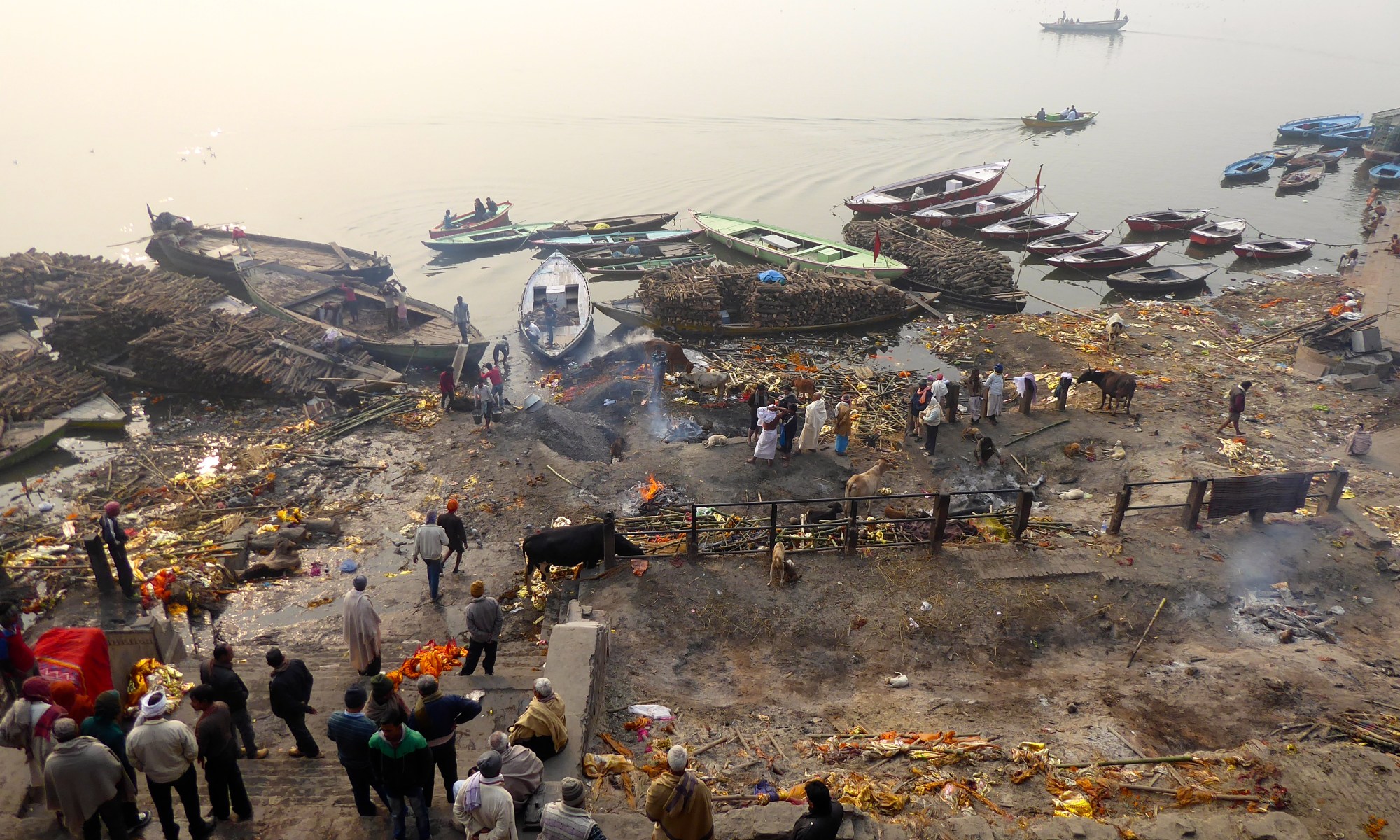
Cremations are permitted at two of these ghats. During one of our riverfront walks we stopped to watch the ceremonies, four or five of them, that were taking place simultaneously up and down the steps. Large branches and chopped tree trunks had been gathered up into piles and set on fire. In the center of each of these lay a person’s body. A pair of bony feet were sticking out of one of the piles. A charred head, blackened and undeniably round, emerged from a closer stack. The river lapped at another body, which had been festooned with floral garlands and was waiting to be washed for the last time.


“But the river brings darkness to India – the Black River”,
says Balram Halway, who is the protagonist in “The White Tiger”, a novel by Aravind Adiga.
“Which black river am I talking of – which river of Death, whose banks are full of rich, dark, sticky mud whose grip traps everything that is planted in it, suffocating and choking and stunting it? Why, I am talking of the mother Ganga, daughter of the Vedas, river of illumination, protector of us all, breaker of the chain of birth and rebirth. Everywhere this river flows, that area is the darkness.
I urge you not to dip in the Ganga unless you want your mouth full of faeces, straw, soggy parts of human bodies, buffalo carrion, and several different kinds of industrial acids.
I went to the holiest spot on the banks of the Ganga, the city of Benaras. I remember going down the steps of a downhill road in the holy city of Benaras, at the rear of a funeral procession carrying my Mother’s body to the Ganga.
We walked past temple after temple, praying to god after god, and then went in a single file between a red temple devoted to Hanuman and an open gymnasium where three body builders heaved rusted weights over their heads. I smelled the river before I saw it: a stench of decaying flesh rising from my right.
Then there was a gigantic noise: firewood being split. A wooden platform had been built by the edge of the ghat, just above the water; logs were piled up on the platform, and men with axes were smashing the logs. Chunks of wood were being built into funeral pyres on the steps of the ghat that went down into the water; four bodies were burning on the ghat steps when we got there. We waited for our turn.”
Balram’s desciption of his mother’s cremation, when they do get their turn, reflects the ceremonies we witnessed:
“As the fire ate away at the satin, a pale foot jerked out, like a living thing: the toes, which were melting in the heat, began to curl up, offering resistance to what was being done to them. Underneath the platform with piled-up fire logs, there was a giant oozing mound of black mud where the river washes into the shore.”
In “The White Tiger”, Adiga splits India into two: the coastal parts of the country, where all is light, and the parts of the country through which the river runs, where all is darkness. This metaphorical darkness is the choking political corruption and institutionalized oppression that reigns over these regions and prevents local people from attaining any kind of emancipation within their lifetimes. The darkness is so crippling that, in this story, Balram’s only means of moving up in the world is to kill his master and steal his money [not a spoiler].
I had always associated the Ganges with extreme pollution, so when we visited its banks I had to find out if something was being done to fix it. I found out that the darkness also incapacitates the hard work of environmental activists.
The Ganges is really an enormous riverine system made up of thousands of tributaries that reach deep into Northern India, covering the country like a great coral. Some of these rivers travel through less densely populated places, and are still fairly clean when they pour themselves into the Ganges. Others have passed through large cities and industrial sites and have become more like sewage channels than streams. In this way, the pollution levels of the Ganges are ever changing along its course. The river may become very dirty where a deeply polluted channel enters it, only to be cleaner further downstream once other, less polluted streams have added themselves to the mix. The river also cleans itself, to a certain extent. The water bubbles and splashes as it flows and as it does so it captures and dissolves oxygen from the air. That oxygen helps the living organisms within it break down the excess organic materials in the water, purifying it.
Varanasi is one of those places where the river is at its most polluted. During the colonial era, the British built the city an underground sewage system that used gravity to divert urban waste water away from religious bathing sites. But it was intended for an urban population of two-hundred thousand. No additions have been made to the city’s sewage system since then, although its population has grown to over a million and a half people. Nowadays, the totality of the city’s household sewage makes its way into the river at dozens of entry points along the waterfront. Simultaneously, each day, sixty-thousand people descend those same Ghats to bathe and drink the holy water.
Just how polluted is the water that they step into? One way of knowing this is by measuring the amount of fecal coliform, a type of bacteria, that’s present in a given sample of water. Fecal coliform is a good indicator of how much fecal matter is floating around because it grows in mammalian intestinal tracts. It’s okay to swim in water that contains some of this bacteria, but any more than five hundred parts in a one hundred milliliter sample of water is probably unsafe. Unfortunately, where some residents of Varanasi bathe, the fecal coliform count is as high as one or two million parts per hundred millilitres. That’s four thousand times too much.


The frustrating thing about all of this is that it’s just so solvable. Of all the filth floating by the city, only five percent of it has come from a place somewhere upstream, outside the city. The rest of it comes from the city itself. That means that redirecting all the city’s sewage into a working treatment plant would make the water people swim in ninety-five percent cleaner.
One morning we walked into a laboratory belonging to the Sanjay Mochan Foundation, an NGO whose quest it is to heal the Ganges. With help from engineers at the Benaras Hindu University and from UC Berkeley, they’ve designed a treatment plant that captures and redirects polluted runoff away from the river without using any of the city’s precious electricity supply. The treatment plant itself consists of a series of ponds and uses algae and sunlight to clean the sewage. The whole process would be carbon negative, meaning that it would draw more carbon dioxide from the atmosphere than it releases. It would also produce water clean enough for agriculture, and some nutrient rich algae that could be used as fertilizer and fish food.
Plenty of money has been aimed at the Indian government to get projects like these underway. It’s no surprise that nothing has happened yet. For most of the people who bathe in the river daily, the notion that the Ganges is polluted is oxymoronic. The Mother Ganga is by definition the great purifier of all things.
Paramahansa Yogananda, a former spiritual leader respected by millions of Indians and westerners, wrote the following in his 1946 autobiography:
“An extraordinary, perhaps unique, feature of the Ganges river is its unpollutability. No bacteria live in its changeless sterility. Millions of Hindus, without harm, use its waters for bathing and drinking. This fact is baffling to modern scientists.”
Public pressure is thus close to nil. That’s not enough to make a corrupt government do good. In a scientific article about the treatment plan, the director of the Sankat Mochan Foundation, Professor V. B. Mishra, summarizes the situation with some heartbreaking words :
“What should we do? Where shall we go? We know that we are doing right things and working with commitment to clean the Ganga and using all our technical skills and energy to achieve the goal of a clean Ganga. This story needs exposure at the widest level. We started working when our hair was black and we are still working for a clean Ganga at Varanasi when our hair has greyed. No tangible results so far.”
Their strategy for now is to keep the government accountable by producing their own, quality data, and to educate the public.
Accounts from the nineteenth century tell of large schools of river dolphins in the Ganges, including close to urban centers. Their population has greatly diminished since then and folks from the Sankat Mochan Foundation tell us that no dolphins have been seen near Varanasi in the last five years. The daily bustle along the waterfront is an easy distraction from such problems. How can a river so sick support so much liveliness? The continuous cremations ensure that death has a sometimes overpowering presence, nevertheless. But as our gaze is pulled towards the inhabitual sight of burning bodies, we miss an even greater cadaver: the Ganges.


Further reading:
Prof. V. B. Mishra’s article: http://www.iisc.ernet.in/currsci/sep102005/755.pdf
The Sankat Mochan Foundation’s website: http://sankatmochanfoundationonline.org
More about the river dolphins: http://wwf.panda.org/what_we_do/endangered_species/cetaceans/about/river_dolphins/ganges_river_dolphin/
 Stars, like salt.