It’s a cool morning in February in north-western India and we’re being guided through a brand new nature reserve on the outskirts of Jodhpur, a city of around a million inhabitants in the Thar Desert of Rajasthan. Sandstone is the dominant feature in this landscape so everything is overwhelmingly orange, except for the reserve’s thriving green flora and the city’s blue-painted homes. I’m crouched over staring at a spider’s web. The web is exceptional because of it’s three-dimensional, almost spherical shape. Its threads connect delicately across the structure’s curved surface like the narrow joints of a stained-glass window. They’re luminescent in the crisp sunlight. This web and its inhabitants occupy the space between the tubular limbs of a large Euphorbia succulent in the Rao Jodha Desert Rock Park, the site of an unlikely environmental overhaul.
Rao Jodha was recently an ecological wasteland. Wedged between the magnificent Mehrangarh Fort and the edge of the indigo city, its 70 acres had been overrun by a highly invasive species of mesquite from Mexico named Prosopis juliflora. In the 1930’s the Maharaja had secured the mesquite’s rampant success by scattering its seeds from his own airplane. This was his way of providing his people with better firewood and more animal fodder. But the wood didn’t burn well and the livestock didn’t take much interest in the mesquite, except for the donkeys, which spread its seeds across northern India as they shuttled goods between regions.


Then, about ten years ago, local officials decided that the city needed another attraction to keep tourists around an extra day. They chose Rao Jodha as the site and did the fashionable thing by stringing it with a ziplining course. But they also thought it economically worthwhile to restore the site’s native ecology. Mesquite hardly needs any water or nutrients to survive making it easy for it to out-compete native species. It also seemed to have pushed out the park’s original plant life by secreting a toxic substance near its roots. Removing it was a complicated saga rife with failure. This species is so recalcitrant that it easily resprouts after being cut at surface level. Digging deeper was challenging because its roots had burrowed half a meter into the ground, not into the park’s soft sandstone but into the unyielding volcanic rock. Drilling with modern tools was too slow. Dynamite was far too destructive. But beneath the ziplines now lies a living museum of rock-loving native plants. Most importantly, the mesquite is gone. How ecologists resolved to get rid of it is a story worth telling.


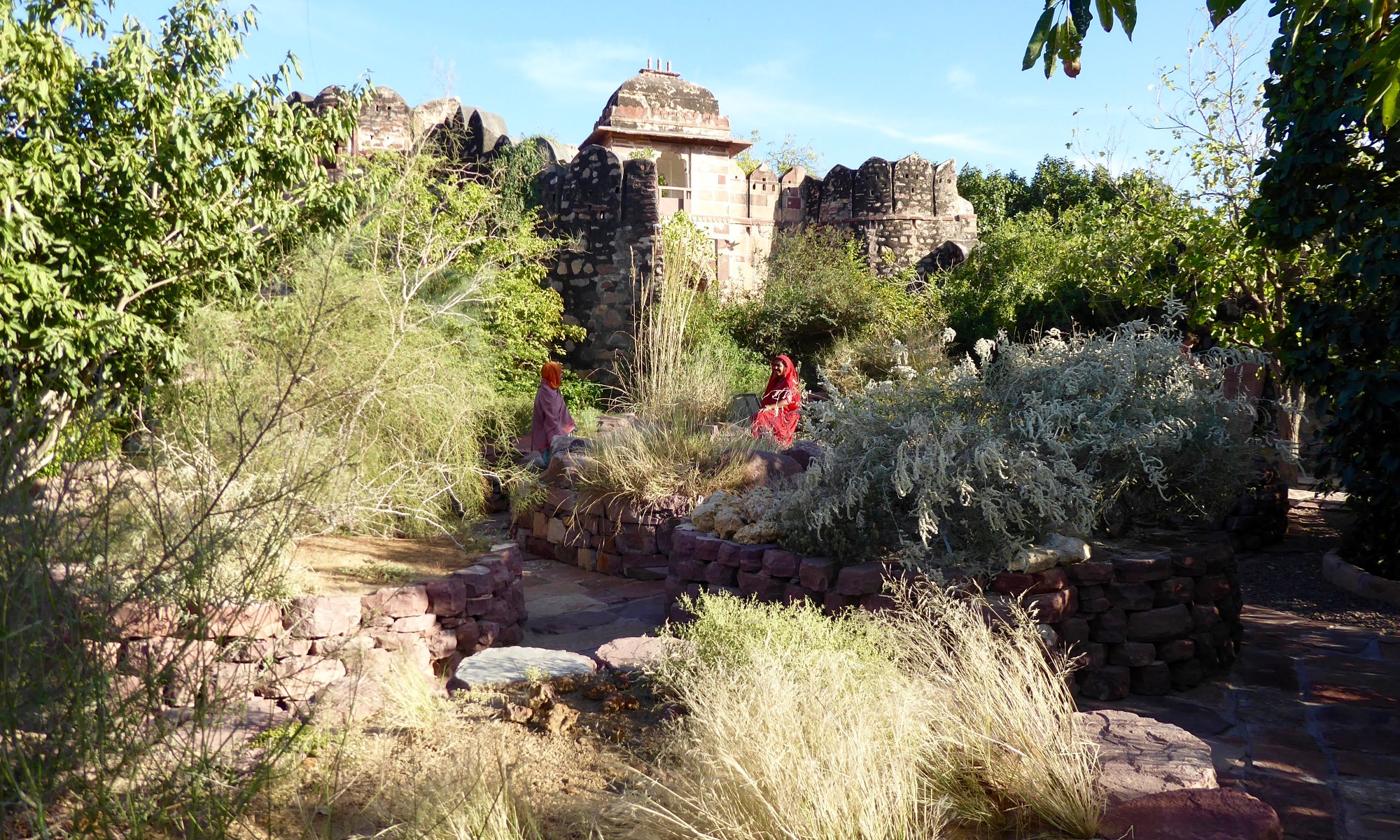
Like entering the lobby of a large building, we leave the busy street and enter a small, lush garden. The garden has plants, soils and rocks from the wider reserve and from across the region. It’s an exquisite miniature of the park as a whole. I feel like I’ve stepped into a lively desert cloister, immured not by an abbey but by the city’s former defensive walls. The walls are made of thick blocks of orange sandstone into which bird houses were long-ago carved. Low trees grow in the shade close to the walls. Three women have discreetly entered the garden and I admire the way their red saris contrast brilliantly with the green vegetation. Most eye-catching is a collection of superbly colourful and iridescent minerals from all over the Thar desert.


In the garden, raised beds filled with different desert soils display the plants best adapted to each one. They’ve been put there to explain why, once the mesquite had been eradicated, re-populating the reserve with local plants was still harder than expected. Despite inhabiting the same overall desert ecosystem, each plant on display has adapted to the precise soil chemistry of its sometimes tiny home region. Some plants prefer soils that are high in calcium from long-ago deposited sea creature skeletons. Others prefer soils full of sodium, growing where salt is all that’s left of an evaporated sea. Not all of these conditions are found in this reserve and so it doesn’t support all native plants.


The reserve’s bedrock is a rugged plateau of 750 year old volcanic rhyolite and 500 million year old sandstone. I can feel ripples in the path’s sandstone slabs press into the soles of my feet. They’re what’s left of an ancient tropical sea. Mineral deposits here match rocks in Madagascar and oceanic fossils high up in the Himalaya. The magnitude of time represented here gives me a head rush. It feels as if the whole history of the world might be contained in this one place.


From the garden we descend into a paved, 17th century drainage leading into the rest of the reserve. During the rainy season the drainage empties into two lakes at the foot of the fort. In the summer, temperatures can climb to fifty degrees Celsius. The drainage provides just enough shade and moisture retention for more sensitive plants to grow. Small shrubs creep from cracks in the walls. We pass through the cover of spiraling neem leaves. A gum vine weaves its way up the wall. It’s also an introduced species. Our guide Denzil says the British unsuccessfully tried to use it to make airplane tyres. But it’s not a particularly aggressive alien and the birds like it so the park’s ecologists have let it be. The same could not have been said of the mesquite.
That early morning, when Denzil finally told us how ecologists had unlocked the mesquite puzzle, something opened up in my mind as well. They hired miners. The “Khandwalias”, as these miners name themselves, are descended from the artisans who, five hundred years ago, chiselled giant sandstone blocks for the fort that now looms over the park. Their skillset is less used these days but remains unmatched by any modern machinery. Before cutting into stone, the Khandwalias first seek to understand it. By hammering at the rock near a plant and listening intently they can learn how deep the rock layer is as well as where it is weakest and thus how to drill into it. In Rao Jodha, their technique broke the rock apart just enough to extract the mesquite roots without significantly damaging it. The pits left behind in the rock then received the soil and native flora used to repopulate the park.


One of the reasons it’s so hard to make environmental progress anywhere in the world is that the people who benefit the most from continuing to pollute and destroy (big corporations, their lobbyists, and the politicians who agree to speak for them) are very good at deflecting attention away from themselves and their harmful actions. In the US for example, decision makers working to slow efforts to reduce emissions from coal-based power plants have all too easily diverted our attention away from their deplorable motives. They’ve distracted the public with a largely fictional, petty war between downtrodden coal miners and the environmental activists whose mission they pretend is focused on taking away coal industry jobs.


Pitting nature-lovers against working-class people is a go-to for big polluters. We’re so battered by this strategy that we’ve become mentally entangled in its confusing, sticky mess of oversimplified stories. Visiting Rao Jodha, which is now brimming with native species of birds and insects and rare plants, was like being briefly transported away from this nightmare into the true narrative. Rather than wielding the economy against the environment, local leaders saw nature as a way to attract more tourists and more money to Jodhpur. Not only that, they had the ingenuity to turn it into an employment opportunity for the category of worker that is seen as losing the most when the environment is cared for. The environment is hardly prioritized in much of India, but in this small part of the country, something clicked.
Pradip Krishen is the environmentalist who led the restoration effort. His rendering of the project is here: http://www.tehelka.com/2012/03/how-the-mad-one-tames-the-desert/?singlepage=1
 Stars, like salt.