
I was surveying the bone-dry San Luis Rey riverbed recently, performing autopsies on crunchy, senescing weeds, when I had a revelation in sound. I heard a newborn bird learning to sing.
First, from a nearby willow, drifted the adult Vireo’s song: a well-formed, two-part warble. Then came baby’s: a squeaky, unfinished attempt tapering into hesitating silence. It was a blissful moment of discovery – birds must learn to sing – and it made me wonder: how do birds sing?
Birdsong is special. Comparing birds to humans shows why. To speak, we force air between our vocal cords, twin membranes atop the trachea, our windpipe. This apparatus is the larynx.
The avian equivalent is the syrinx, and birds in fact have two. Lacking vocal chords, birds vary their songs’ loudness and intensity by adjusting the tension of the membrane in the syrinx, like a musician tightens a drum. The double syrinx occurs because it is located where the trachea splits into two.
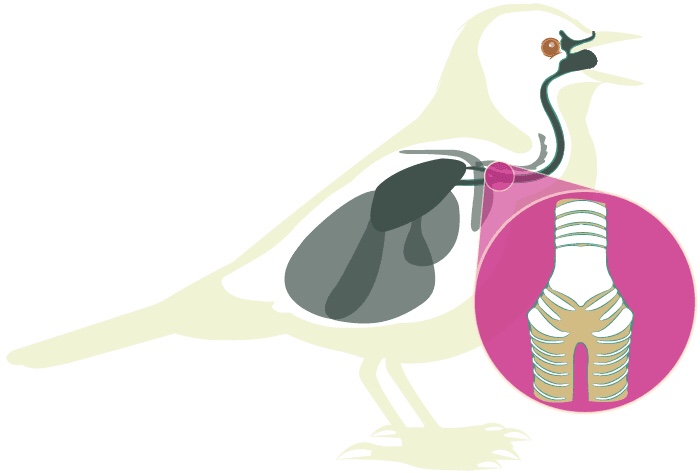
By using both bronchi, birds can produce two distinct sounds at once. This feature enables many of their most complex songs. Some birds can sing high and low or ascending and descending notes simultaneously. Other birds quickly oscillate between two notes. The lyre bird, for example, is an astonishing mimic of most noises, from the songs of other birds to construction clamor.
For now, my baby Vireo has its work cut out mastering its own kin’s song. The tune it finally chooses, or “crystalizes”, will likely stick for life.
 Stars, like salt.