
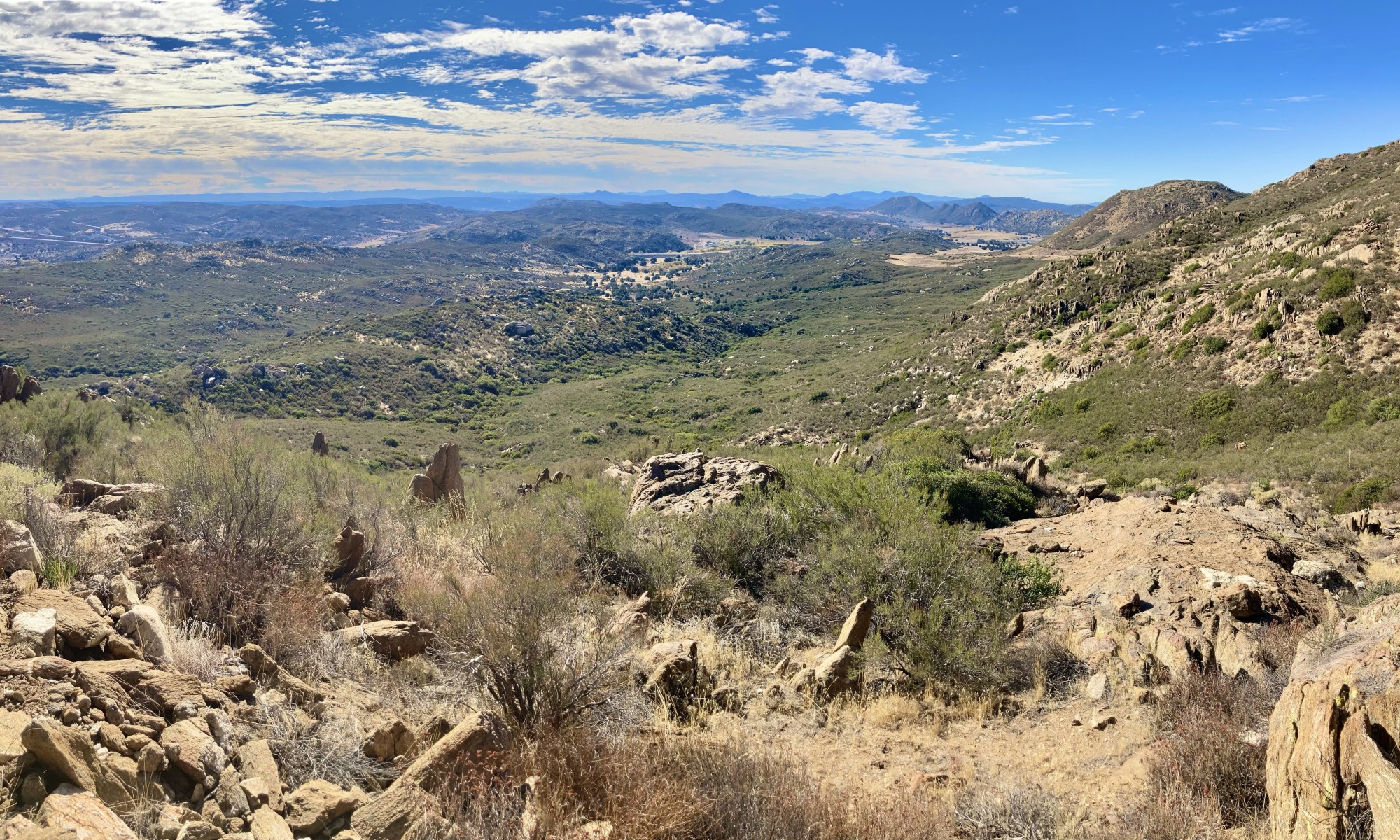
Since January, in time made around work, I’ve been taking classes in Kumeyaay studies. The Kumeyaay are the original native people of San Diego County and northern Baja California. The Kumeyaay Community College, which is partnered with the Grossmont-Cuyamaca community college system, offers classes on the Kumeyaay language, in Kumeyaay history, in Kumeyaay arts and humanities, and in Kumeyaay ecology and botany.
In my first semester, I took the introductory language class and the botany class. In the language class, we worked on gaining basic vocabulary and began to string together sentences with radically different grammar. Kumeyaay being an oral language, we tried to forget our attachment to reading and writing as a way to learn to speak. We caught glimpses of Kumeyaay customs and perspectives, including their creation story, seeping into the language. And since the arts and humanities class often carried on into the ensuing language class, we frequently did this while practicing pottery-making, cordage, and building traditional boats. More than becoming a student again, taking this class dropped me into a community of people committed to the urgent task of reviving the Kumeyaay language and culture before it disappears. I noticed with some interest that my classmates broadly belonged to two groups; either they were Indigenous or they were like me; people with blurry, multinational origin stories already speaking several languages. Maybe it’s easier for diverse people to value diversity in human kind. Like a biodiverse ecosystem, humanity is more beautiful and more resilient as a whole the more diverse are its parts.
Meanwhile, our two botany professors led us on a journey through plant evolution and traditional plant uses. We used plant species native to San Diego to illustrate what we were learning: we collected specimens, cut cross sections, and drew. We learnt to identify, at a glance, what plant family a species belongs to and some of its many adaptations for survival and reproduction. Then we applied those learnings to understand how and why the Kumeyaay people use specific species for specific purposes. We saw how different environmental pressures provoke the development of specific plant characteristics, like new tissue types, reproductive strategies and chemical compounds, making different species better suited for different uses, such as food, medicine, clothing, shelter and tools. The class was deeply scientifically enriching. It also showed me what should have always been plain to see: the total integration of the Kumeyaay within their environment, and what we have lost by artificially separating humans from nature.
Below is a presentation I created during my botany classes providing a botanical introduction to Kumeyaay basketry.
 Stars, like salt.